
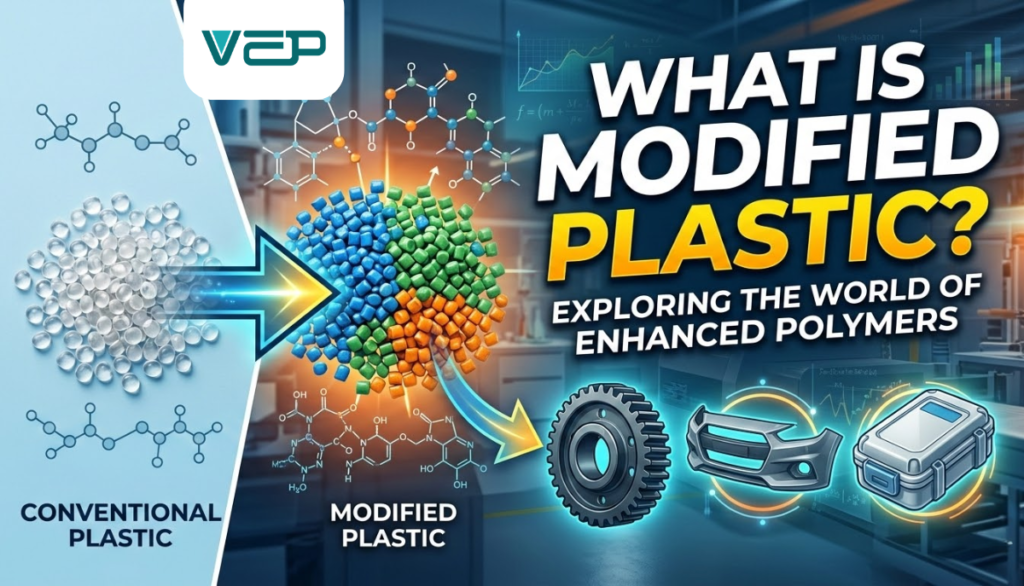
What is Modified Plastic?
Modified plastic is a type of plastic whose structure has been altered or enhanced by adding additives or modifying the original polymer properties. Compared with conventional plastics, modified plastics can meet higher technical requirements such as:
- UV resistance
- Better heat resistance
- Higher durability
- Flame retardancy
- Anti-static properties
Limitations of Conventional Plastics
Why Manufacturers Often Need to Look for Correct Materials
In many industrial applications, conventional plastics sometimes cannot meet certain technical requirements such as:
- High heat resistance
- Strong impact resistance
- Flame retardancy
- Anti-static properties
As a result, manufacturers often need to look for materials with enhanced performance.
When Materials Fail to Meet Requirements
Using an unsuitable plastic material can lead to several issues, including:
- Deformation at elevated temperatures
- Shorter product lifespan
- Increased risk of component failure
This is especially critical in industries such as electronics, home appliances, and automotive engineering, where selecting the wrong material can significantly increase manufacturing and warranty costs.
Characteristics of Modified Plastics
Depending on the type of modified plastic, different materials may offer different advantages. However, in general, modified plastics provide improvements over conventional plastics in the following areas:
High Mechanical Strength
Modified plastics are often reinforced with materials such as:
- Glass fiber
- Mineral fillers
- Technical additives
These reinforcements help improve the mechanical strength and durability of the material.
Good Stability
Modified plastics are capable of withstanding:
- High temperatures
- Chemical environments
- Harsh operating conditions
This makes them suitable for demanding industrial applications.
Flexible Material Design
Manufacturers can adjust the material formulation to achieve specific properties required for particular applications.
How Does Compound Plastic Differ from Other Types of Plastic?
| Criteria | Modified Plastic | Recycled Plastic | Compound Plastic | Virgin Plastic |
|---|---|---|---|---|
| Origin | Plastic whose properties are improved by adding additives or modifying the material structure | Recycled from used plastic products or plastic scrap | Polymer blended with additives or reinforcing materials according to a specific formulation | Produced directly from petrochemical raw materials (oil or natural gas) |
| Purity | Depends on the base polymer and additives | Lower due to possible impurities | Depends on the compound formulation | Very high |
| Customization Capability | High – focuses on enhancing one or more specific properties | Low | High – properties can be tailored to specific requirements | Low (properties are fixed by the polymer structure) |
| Quality Stability | Stable but dependent on modification formula | May vary depending on the source material | Stable if produced with a controlled formulation | Very stable |
| Cost | Medium to high | Lowest | Medium to high | Highest |
| Typical Applications | Products requiring special properties such as flame resistance, heat resistance, or anti-static performance | Packaging, general plastic products, household goods | Technical components, electrical equipment, automotive parts, home appliances | High-quality products, technical components, electronic devices |
| Example Materials | Flame-retardant ABS, glass-fiber reinforced PP | Recycled ABS, Recycled PP | PP compound, ABS compound | ABS, PP, PA, POM |
In simple terms:
- Virgin plastic is the “original” plastic produced directly from petrochemical plants.
- Recycled plastic is plastic that has been reprocessed from used plastic products.
- Compound plastic is plastic blended with additives to create new properties.
- Modified plastic is plastic whose technical properties have been improved, such as enhanced flame resistance, heat resistance, or strength.
In practice, modified plastics are often produced in the form of compound plastics, since the compounding process allows polymers to be evenly mixed with the necessary additives.
Applications of Modified Plastics
Modified plastics are widely used across various industries, including:
Electrical and Electronics
- Device housings
- Insulating components
Home Appliances
- Appliance casings
- Heat-resistant components
Automotive Engineering
- Interior components
- Technical structural parts
If your company is looking for compound plastics or modified plastics suitable for your manufacturing applications, the technical team at VEP can assist you in selecting the right material and providing the appropriate solution. Contact VEP today to receive expert consultation on plastic materials for your project.
Frequently Asked Questions about Modified Plastics
Is modified plastic the same as compound plastic?
In many cases, modified plastics are produced in the form of compound plastics, where the base polymer is blended with additives or reinforcing materials.
Is modified plastic more expensive than conventional plastic?
Modified plastics are generally more expensive, but they offer improved performance and longer product lifespan.
Which industries commonly use modified plastics?
Modified plastics are widely used in industries such as electronics, home appliances, automotive engineering, and technical manufacturing.