
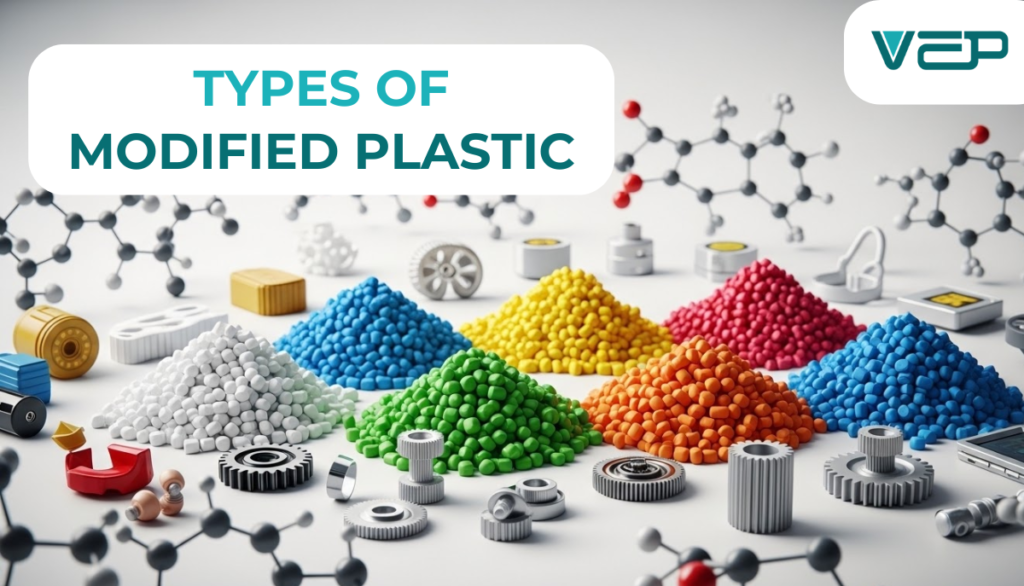
How Many Types of Modified Plastics Are There?
Can a plastic material be engineered to meet almost any technical requirement?
In today’s industrial landscape, plastics are no longer just basic materials. Many products require specific properties such as heat resistance, flame retardancy, anti-static performance, or enhanced mechanical strength. To meet these demands, manufacturers often rely on modified plastics.
Modified plastics are created by adding additives or reinforcing materials to a base polymer, allowing the material’s original properties to be improved or altered. As a result, these plastics can be used in a wide range of technical applications where conventional plastics may fall short. So, how many types of modified plastics are there, and how are they used in manufacturing?
What is Modified Plastic?
Modified plastic refers to a type of plastic whose properties have been improved or altered by incorporating additives, reinforcing agents, or fillers. This modification process is typically carried out during plastic compounding, where the base polymer is blended with other materials in an extrusion system to produce compound pellets.
Through modification, plastics can achieve properties that the original polymer does not possess, such as:
- Improved mechanical strength
- Enhanced heat resistance
- Flame retardancy
- UV resistance
- Anti-static performance
How Many Types of Modified Plastics Are There?
In practice, modified plastics can be classified in several ways. However, in industrial production, the most common types include the following:
1. Glass Fiber Reinforced Plastics
Characteristics
Glass fiber reinforced plastics are produced by adding glass fibers to base polymers such as PP, PA, or ABS. These fibers significantly increase the stiffness and strength of the material.
Advantages
This type of plastic offers several key benefits:
- High mechanical strength
- Excellent load-bearing capacity
- Reduced deformation under stress
Thanks to these properties, glass fiber reinforced plastics are often used as a replacement for certain metal components.
Applications
Glass fiber reinforced plastics are commonly used in:
- Technical components
- Machinery parts
- Industrial equipment
- Automotive engineering
Using this material helps reduce product weight while maintaining the required strength.
2. Flame Retardant Plastics
Characteristics
Flame retardant plastics are produced by adding flame retardant additives to the base polymer. These additives help reduce flammability or slow down the combustion process.
Advantages
Flame retardant plastics can:
- Reduce the risk of fire spreading
- Improve product safety
- Meet technical standards in electrical and electronics industries
Applications
Flame retardant plastics are widely used in:
- Electrical equipment
- Electronic device housings
- Electrical components
This type of material is essential in industries with strict fire safety requirements.
3. Anti-Static Plastics
Characteristics
Anti-static plastics are modified by adding antistatic agents or conductive additives to reduce the accumulation of electrical charges on the material surface.
Advantages
These materials help:
- Minimize static charge buildup
- Reduce the risk of electrostatic discharge (ESD)
- Protect sensitive electronic components
Applications
Anti-static plastics are commonly used in:
- Electronic components
- Electrical devices
- Protective packaging for electronic parts
4. Heat-Resistant Plastics
Characteristics
Heat-resistant plastics are modified to improve the thermal resistance of the polymer. This can be achieved by adding specific additives or selecting base polymers with higher heat resistance.
Advantages
Heat-resistant plastics can:
- Maintain shape stability at high temperatures
- Reduce deformation during long-term use
- Extend product lifespan
Applications
These materials are widely used in:
- Home appliances
- Technical components
- Electrical and electronic equipment
The Role of Compound Plastics in Producing Modified Plastics
In many cases, modified plastics are produced in the form of compound plastics. The compounding process allows manufacturers to:
- Blend polymers with additives
- Control material ratios precisely
- Produce pellets with consistent properties
As a result, manufacturers can create materials tailored to specific applications. You can learn more in the article: What is Compound Plastic?
When Should You Use Modified Plastics?
Modified plastics are typically used when products require:
- High mechanical strength
- Heat resistance
- Flame retardancy
- Anti-static properties
For technical products or industrial components, using modified plastics can significantly improve both performance and durability.
Choosing the Right Material for Your Application
Selecting the right plastic material plays a crucial role in optimizing production costs and improving product quality.
If you are looking for compound plastics or modified plas. Contact VEPContact VEP today to get professional advice on plastic materials for your project.

Frequently Asked Questions about Modified Plastics
Is modified plastic the same as compound plastic?
In many cases, modified plastics are produced in the form of compound plastics, where the base polymer is blended with additives to enhance material properties.
Is modified plastic more expensive than conventional plastic?
The cost of modified plastics depends on the type of additives and material formulation. However, in many applications, the higher cost is offset by improved durability and performance.
Which industries use modified plastics?
Modified plastics are widely used in industries such as electronics, home appliances, automotive engineering, and various technical manufacturing sectors.
Pingback: What is Modified Plastic? – VEP